Quick Answer
Anyone trying to size the Muslim market in the USA runs into the same problem: the US Census does not ask about religion, so every population figure is an estimate, and the estimates differ. This page puts the main numbers side by side with their sources so you can use them with confidence. We update it as new data is published. All figures were checked on November 19, 2026.
How many Muslims live in the USA?
The Pew Research Center estimate is the most conservative and the most cited. CAIR and DinarStandard use broader methods. The honest way to cite the market is to give the range, 5.5 to 8 million, and name the source for whichever figure you use. The Wikipedia entry on Islam in the United States tracks the debate over these estimates.
| Source | Estimate | Year | Note |
|---|---|---|---|
| Pew Research Center | About 5.5 million (all ages) | September 2026 | Up from 2.4 million in 2007 and 3.45 million in 2017 |
| DinarStandard | 7.47 million | 2025 | Used in the Thrive Summit research |
| CAIR | About 8 million, 2.5 million registered voters | 2026 | From its 2026 election plan; the 2.5 million registered voters are in twelve decisive states |
How fast is the US Muslim population growing?
Growth comes from immigration, higher birth rates and a young age profile. The 2050 projection was published before the 2026 estimate, so the real path may be faster.
| Year | Pew estimate | Note |
|---|---|---|
| 2007 | 2.4 million | Pew baseline |
| 2017 | 3.45 million | 1.1 percent of the US population |
| 2026 | 5.5 million | Latest Pew estimate |
| 2040 (projection) | Second largest US religious group | Pew projection |
| 2050 (projection) | 8.1 million, 2.1 percent of population | Pew projection |
How much do Muslim Americans spend?
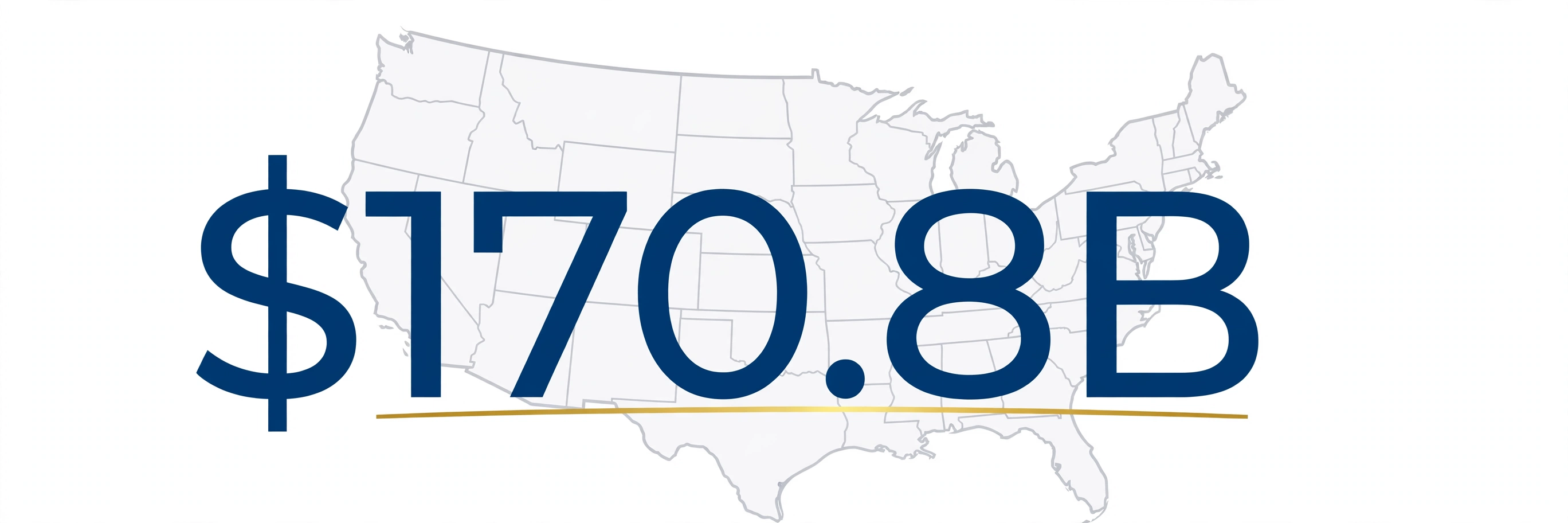
DinarStandard, in research prepared for the Thrive Summit, estimates US Muslim consumer spending at $170.8 billion in 2024. The same research counts 57,016 Muslim owned small and medium businesses across the US and the Toronto area, with US Muslim owned SMEs generating $46.9 billion in revenue. Those businesses cluster in California, Texas, Florida and New York.
A note on income: ISPU's 2025 poll puts the share of Muslim households earning $100,000 or more at 24 percent. Older ISPU polls gave lower figures for earlier years, which is a change over time, not a contradiction.
| Measure | Figure | Source |
|---|---|---|
| US Muslim consumer spending | $170.8 billion (2024) | DinarStandard |
| Revenue of US Muslim owned SMEs | $46.9 billion | DinarStandard |
| Muslim owned SMEs in the US and Toronto area | 57,016 | DinarStandard |
| Share self employed | 8 percent of Muslim American adults | ISPU 2025 |
| Share who are students | 47 percent | ISPU 2025 |
| Share with a college degree | 36 percent | ISPU 2025 |
| Share of households with income of $30,000 or less | 35 percent | ISPU 2025 |
What do Muslim consumers want that the market is not providing?
DinarStandard's North America survey asked Muslim consumers which needs are least served. The top answers were housing finance (39 percent), investments and savings (34 percent) and personal insurance and pensions (34 percent). All three point to Islamic finance: products that avoid interest and speculation. The same research found that Islamic values are very or extremely important to 59 percent of Muslim consumers when buying food and dining, 52 percent for clothing and 45 percent for travel.
For a founder, that is a map of opportunity. For a brand, it is a warning: a product that ignores those values will struggle no matter how large the headline market looks. Our guide to marketing to Muslim consumers turns these numbers into a plan.
How does the US compare with the global Islamic economy?
DinarStandard's State of the Global Islamic Economy report for 2025 and 2026 puts global Muslim spending at $2.6 trillion in 2024, projected to reach $3.56 trillion by 2029. Halal food alone was $1.53 trillion and Islamic finance assets were $5.99 trillion. The US market at $170.8 billion is a small share of the global figure, but it is growing quickly: Pew's population estimate more than doubled between 2007 and 2026.
Why does this matter for business owners and sponsors?
Three reasons:
If your customers are the founders behind that $46.9 billion in revenue, 300 of them gather at the AMCOB LEAD Summit in Chicago, June 5 to 6, 2027. Sponsorship options are on the sponsorship page.
Frequently asked questions
How big is the Muslim market in the USA?
About $170.8 billion in annual consumer spending (DinarStandard, 2024), across 5.5 to 8 million people depending on the source.
How many Muslims are in the United States in 2026?
Pew Research Center estimates about 5.5 million. CAIR estimates about 8 million. The Census does not record religion, so all figures are estimates.
How many Muslim owned businesses are in the USA?
DinarStandard counts 57,016 Muslim owned small and medium businesses across the US and the Toronto area, with US Muslim owned SMEs generating $46.9 billion in revenue.
Which states have the most Muslim owned businesses?
California, Texas, Florida and New York, according to DinarStandard.
Is the Muslim population in the USA growing?
Yes. Pew's estimate rose from 2.4 million in 2007 to 5.5 million in 2026, and Pew projects 8.1 million by 2050.